
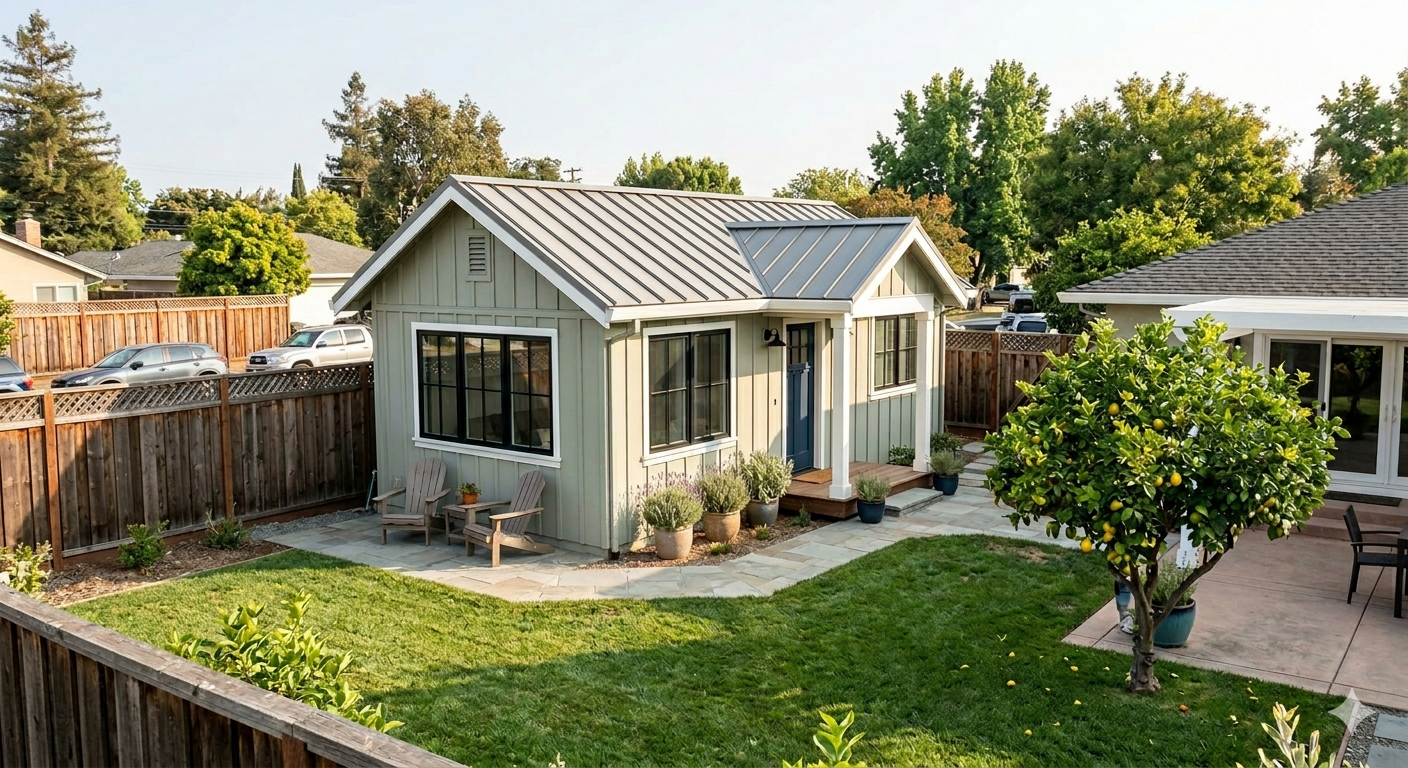
Building a Detached ADU (Backyard Cottage) in California: What You Need to Know in 2026
A detached ADU, what most people call a backyard cottage or backyard unit, is the most flexible and value-adding ADU type available to California homeowners. It is fully independent from the main house, can be rented to any tenant, and typically adds the most to a property’s resale value. Here is a complete guide to building one in 2026.
What Is a Detached ADU?
A detached ADU is a separate residential structure located on the same lot as a primary dwelling. It has its own foundation, walls, roof, kitchen, bathroom, and entrance. It is completely independent from the main house. A detached ADU can house a family member, a long-term tenant, or in some cases a short-term guest depending on local rental rules.
How Large Can a Detached ADU Be in California?
State law sets clear minimums that every California city must allow:
Studio or one-bedroom detached ADU: minimum of 800 square feet must be permitted. Local agencies may allow up to 850 square feet as the floor for a one-bedroom unit.
Two or more bedrooms: up to 1,000 square feet must be permitted.
Local ordinances may allow up to 1,200 square feet or more. Always check your specific city’s ordinance and confirm with your contractor what the maximum allowable size is for your lot.
(Gov. Code, § 66321.)
What Are the Setback Requirements?
The maximum rear and side setbacks a city can require for a new detached ADU are 4 feet. No front setback applies specifically to ADUs under the ministerial approval pathway. Cities cannot require setbacks greater than 4 feet for side and rear yards. (Gov. Code, § 66314.)
How Tall Can a Detached ADU Be?
State law allows up to 16 feet for detached ADUs. If the property is within a half-mile of a major transit stop or high-quality transit corridor, or on a lot with a multifamily dwelling, up to 18 feet is allowed. Local ordinances may permit more. In transit-rich areas like Dublin (near BART) and Antioch (near the Antioch BART station), many properties qualify for the 18-foot allowance.
Do I Need to Replace Parking Spaces?
No. Building a detached ADU does not require replacement parking. If you have a driveway, the parking requirement is satisfied. (Gov. Code, § 66314.)
What Does It Cost to Build a Detached ADU?
Costs vary significantly by location, size, and finishes. Rough ranges for the East Bay and Tri-Valley:
Antioch and Pittsburg: $150,000 to $220,000 for a 600 to 800 sq ft detached ADU with standard finishes.
San Ramon and Dublin: $185,000 to $290,000 for comparable scope, reflecting higher labor and material costs.
These numbers include design, engineering, permits, and construction.
Does a Detached ADU Need Fire Sprinklers?
Not if your primary home does not have fire sprinklers. The construction of a detached ADU cannot be used as a reason to require sprinklers in the main house or in the ADU itself if the primary dwelling does not already have them. (Gov. Code, § 66323, subd. (d), per SB 543, effective January 1, 2026.)
More Reading
- How Long Does It Take to Get an ADU Permit in California?
- California ADU Impact Fees: What You Are Exempt From
- How Much Rental Income Can You Make from an ADU in the East Bay and Tri-Valley?
- ADU vs. JADU — What Is the Difference?
- California ADU Laws in 2026: What Changed
How Do I Get Started?
Start with a licensed contractor who has built detached ADUs in your city. VC Renovate has active detached ADU and garage conversion projects in the East Bay and Tri-Valley, serving Antioch, San Ramon, and Dublin.
Call (925) 788-1632 or email info@vcrenovate.com. CSLB #1147209.
