
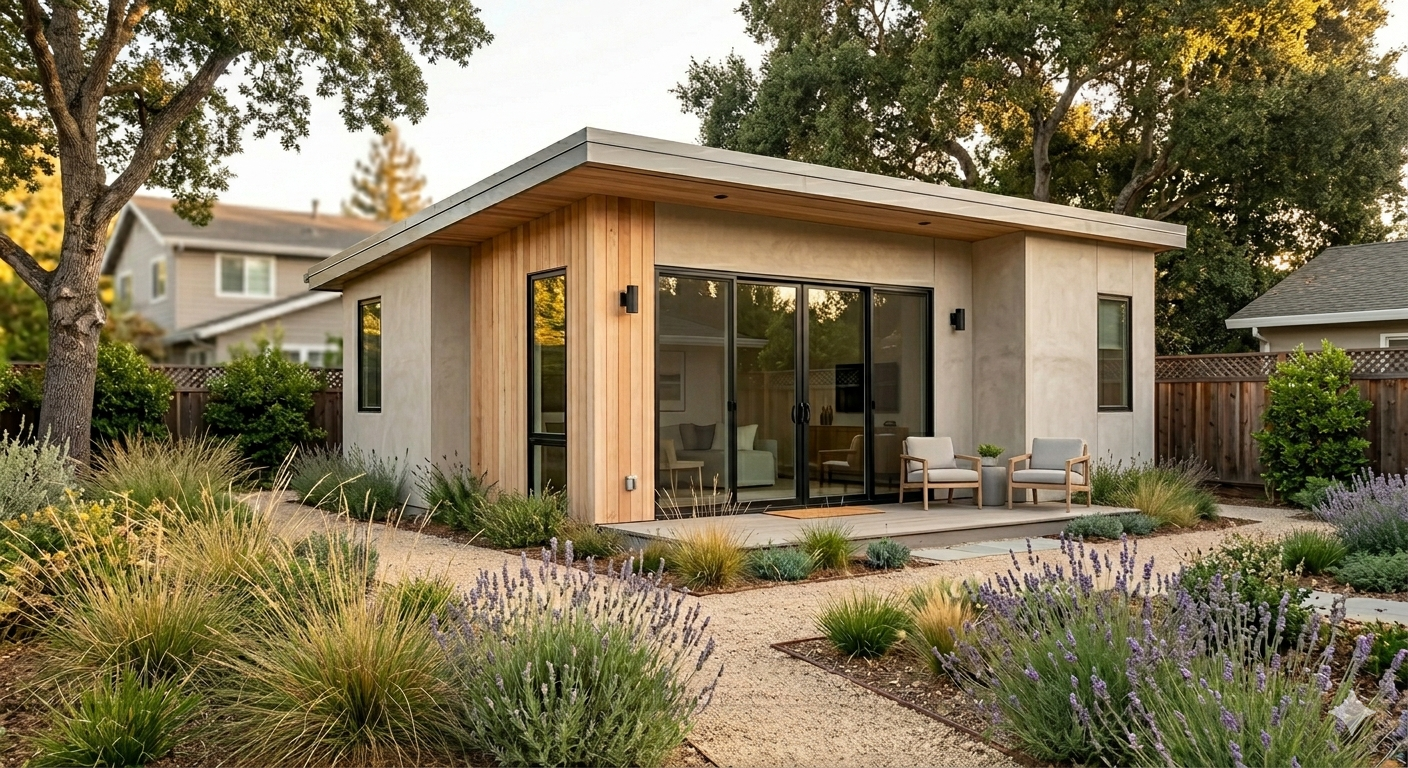
California ADU Laws in 2026: What Changed and What It Means for Homeowners
California’s ADU law landscape has been evolving rapidly since 2019, and 2025 and 2026 brought another round of significant updates. If you are planning an ADU project, understanding what changed will help you know exactly what your rights are and what the city can or cannot do.
SB 543 (Effective January 1, 2026) — The Big One
SB 543 was the most comprehensive ADU legislation of the 2025 session. Here is what it changed:
JADU size definition clarified: A JADU is now defined as no more than 500 square feet of interior livable space. (Gov. Code, § 66313, subd. (d).)
Impact fee exemption updated: ADUs with 750 square feet or less of interior livable space and all JADUs are now fully exempt from impact fees. ADUs over 750 sq ft are subject only to proportional fees. The threshold is now based on interior livable space, not gross square footage. (Gov. Code, § 66311.5.)
15-day completeness determination required: Cities must now determine whether your application is complete within 15 business days and provide written notice. If incomplete, they must tell you exactly what is missing. (Gov. Code, § 66317, subd. (a)(2).)
Fire sprinklers clarified for JADUs: JADUs cannot require fire sprinklers if the primary dwelling does not have them, and a JADU cannot trigger the fire sprinkler requirement for the main home.
School fees: ADUs under 500 sq ft do not increase assessable space and therefore are not subject to school fees.
AB 1154 (Effective January 1, 2026) — JADU Owner Occupancy and Short-Term Rentals
AB 1154 changed two things about JADUs specifically:
Owner occupancy for JADUs with shared sanitation: If a JADU shares sanitation (bathroom) with the primary dwelling, owner-occupancy of either the JADU or the primary home is required. If the JADU has its own bathroom, owner-occupancy is not required.
No short-term rentals for JADUs: JADUs can no longer be used as short-term rentals (under 30 days). If a JADU is rented at all, it must be rented for periods of more than 30 days. (Gov. Code, § 66333, subd. (g).)
AB 130 (Effective June 30, 2025) — HOA Fee Restrictions
AB 130 clarified that HOA covenants, conditions, and restrictions cannot include any fees or other financial requirements in connection with ADU construction. This closes a loophole where HOAs were using financial penalties or review fees to discourage or effectively block ADU projects. (Civil Code, § 714.3, subd. (b).)
AB 2533 (Effective January 1, 2025) — Unpermitted ADUs
This law made it significantly harder for cities to deny permits for unpermitted ADUs built before January 1, 2020. Cities can only deny based on health and safety findings, not general code noncompliance. Cities also cannot charge impact or connection fees for legalizing pre-2020 units. (Gov. Code, § 66311.7.)
AB 976 and AB 1033 (Effective January 1, 2024) — Owner Occupancy and Separate Sale
AB 976 permanently eliminated owner-occupancy requirements for ADUs. No local agency can require you to live on the property to build or rent an ADU.
AB 1033 authorized cities to adopt ordinances allowing ADUs and primary dwellings to be sold separately as condominiums.
What Has Not Changed
The core ADU rights that have been in place since the 2019 and 2020 reform era remain fully intact: ministerial approval, no neighbor hearings, no minimum lot size requirements, 4-foot maximum setbacks for detached ADUs, no replacement parking for conversions, HOA CC&R preemption under Civil Code sections 714.3 and 4751, and the 60-day permit approval window.
More Reading
- ADU vs. JADU — What Is the Difference?
- California ADU Impact Fees: What You Are Exempt From
- Can Your HOA Block Your ADU in California?
- California ADU Owner Occupancy Rules
- How to Legalize an Unpermitted ADU in California
- How Long Does It Take to Get an ADU Permit in California?
Questions About How the New Laws Affect Your Project?
VC Renovate stays current on California ADU law and applies it to every project we build. Serving Antioch, San Ramon, and Dublin. Call (925) 788-1632 or email info@vcrenovate.com. CSLB #1147209.
